




|
"4X5" is generally considered the smallest "large format" film. 8X10 and larger sizes are also used, but they are proportionately more cumbersome, and would limit my mobility in the field. A "technical field camera" is a type of view camera. It is usually of metal construction, consisting of a rear box that holds the ground glass for focusing (the image is upside-down) and the film holder; a front frame that holds the lens; a bed with rails for moving the lens forward and back to focus the image, and a bellows between the rear box and the front frame, to keep the light out and provide flexibility to adjust the lens and rear box. The field camera has less adjustability (next paragraph) than typical studio cameras, in return for advantages in size and weight -- field conditions seldom require the degree of adjustment available in studio cameras, and the field camera easily folds up into a compact, well-protected package. Besides the large film, this type of camera allows a level of control over the image that most cameras can't muster. For example, the lens is mounted to the camera in such a way that it can be tilted up or down, or swung left or right (or a combination of the two), to adjust the relationship between the plane of the film and the plane on which the camera is focused. For example, by tilting the lens down, it is possible to focus sharply on the surface of a pond, from near to far, even at maximum aperture. An example of this is Image #9164. And by shifting the lens, it is possible to, in effect, look up at a tall building while keeping parallel lines parallel. An introduction to view cameras can be found here. [NOTE: "Tilt/shift" or "perspective-control" lenses are available for digital single-lens reflex (DSLR) cameras that provide similar control over perspective and the plane of focus.] There are a number of good books on the subject of large-format photography. I would recommend Using the View Camera by Steve Simmons. If Simmons' book is unavailable, I'd suggest Large-Format Photography (Kodak Publication #O-18E); other books are available. |
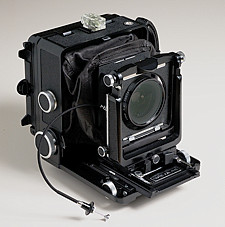 The type of view camera I used for many years prior to "going digital" in 2005 is called a "4x5 technical field camera." "4X5" means that the film it uses comes in
sheets (rather than rolls) measuring four inches by five inches. Because this is so much larger
than 35mm film (which is about 1X1.5 inches), it isn't necessary to enlarge the image as much to
create a print of a certain size. Also, the larger film area is able to capture more image
"information," just as you can write more on a large piece of paper than you
can on a small one. This adds up to more-detailed images. Even at an image size of 23X29
inches, the amount of detail is stunning (see
The type of view camera I used for many years prior to "going digital" in 2005 is called a "4x5 technical field camera." "4X5" means that the film it uses comes in
sheets (rather than rolls) measuring four inches by five inches. Because this is so much larger
than 35mm film (which is about 1X1.5 inches), it isn't necessary to enlarge the image as much to
create a print of a certain size. Also, the larger film area is able to capture more image
"information," just as you can write more on a large piece of paper than you
can on a small one. This adds up to more-detailed images. Even at an image size of 23X29
inches, the amount of detail is stunning (see